
MEDICAL EDUCATION

Notes for the Primary Care Teachers
WHAT DO WE HOPE TO ACHIEVE IN FAMILY PRACTICE TRAINING AND HOW
A brief look at the current trends in medical education
SC Chan, BSc, MD, FRACGP, FAMM, PG Cert Med Edu
Principal Lecturer in Primary Care, Universiti Kuala Lumpur – Royal College of Medicine Perak
Address for correspondence: Professor Chan Sook Ching, Royal College of Medicine Perak, 3 Jalan Greentown, 30450 Ipoh, Perak Darul Ridzuan, Malaysia. Tel: 605-2432635, Fax: 605-2432636, Email: csching@rcmp.unikl.edu.my
Chan SC. What do we hope to achieve in family practice training and how. Malaysian Family Physician. 2007;2(1):22-24
Editor’s note: This is the first article in a new series on medical education: Notes for the Primary Care TeachersFor new teachers and mentors in family practice, you are embarking on a career (part time or fulltime) that is both challenging and rewarding. You may be at a loss as to how to start to become a good teacher or mentor. Understanding that need, this new series of short notes will hopefully provide some tips on specific areas of concern like how to prepare a tutorial, to give feedback, mentoring and touch on various teaching and assessments methods available.
In this first article I would like to give you an overview on some current trends in medical education – on what we hope to achieve in our students and how, before other authors go into specific areas of teaching in later articles.
Outcome based curriculum
The current trend in medical education is to look not at the process but more at the outcomes you hope to achieve in your students and work backwards. For example in undergraduate medical school, the aim is to produce an undifferentiated doctor who can function safely and effectively under supervision as a member of a team in our local health care setting while undergoing further training for future practice. Postgraduate vocational family practice training aims to produce doctors who can function effectively and competently in independent clinical practice.
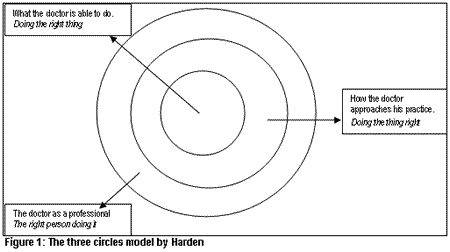
What are the essential competencies required to achieve the above outcomes? Different medical schools and professional bodies like the Royal Australian College of General Practitioners (RACGP) offering vocational training of family doctors have come out with their own aims and objectives but all these can fit into a generic model by Harden1 (see Figure 1) which covers 12 outcomes in 3 circles or areas which are as follows: