


TEST YOUR KNOWLEDGE

A 55 YEAR-OLD MAN WITH LETHARGY FOR SIX MONTHS
KY Loh MMed(FamMed UKM), Department of Family Medicine, International Medical University, Seremban
Address for correspondence: Associate Professor Dr Loh Keng Yin, International Medical University, Jalan Rasah, 70300 Seremban, Malaysia. Tel: 06-7677798, Fax: 06-7677709, Email: kengyin_loh@imu.edu.my
Loh KY. Test Your Knowledge: A 55 year-old man with lethargy for six months. Malaysian Family Physician. 2007;2(3):129-30
A 55 year old factory worker presents with generalized lethargy and unwell for 6 months duration. His father was treated for pulmonary tuberculosis one year ago. His chest radiograph and serum electrolytes obtained in the primary care clinic are shown below: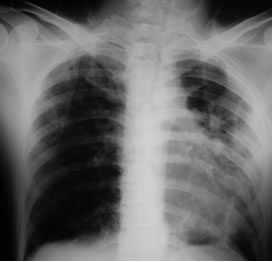
Table: Serum electrolytes
| Test | Results | Normal range |
Sodium |
116 mmol/L |
135-145 mmol/L |
Potassium |
3.0 mmol/L |
3.5-4.5 mmol/L |
Chloride |
74 mmol/L |
95-105 mmol/L |
Urea |
3.2 mmol/L |
3-7 mmol/L |
Creatinine |
64 µmol/L |
60-120 µmol/L |
Question
- Interpret the chest radiograph and the serum electrolytes.
- What is the diagnosis?
- Explain the pathogenesis of the abnormal serum electrolytes.
Answer
His chest radiograph showed prominent opacities at both apices, as well as left upper and middle zones. His serum electrolytes showed hyponatremia and hypokalemia. Other parameters were also at the lower margin of the normal range.
In view of the history and investigation results, the most likely diagnosis is pulmonary tuberculosis with syndrome of inappropriate of antidiuretic hormone secretion (SIADH). He was admitted to hospital for further investigation. His sputum direct smear for acid fast bacilli was positive (4+) suggestive of active pulmonary tuberculosis. Plasma osmolality was 230 mOsm/kg (normal range: 275-295 mOsm/kg) and urine osmolality was 850 mOsm/kg (normal range: 500-800 mOsm/kg). Renal ultrasound did not show significant pathology. He was discharged well following the anti-TB treatment without any further complication. His electrolytes normalized following the treatment.
Active tuberculosis presents with SIADH is a well known entity especially in severe untreated tuberculosis or tuberculous meningitis.1,2 Hyponatremia alone is reported up to 30% of patients diagnosed with tuberculosis.3 Although tuberculosis is considered a cause of SIADH, circulating vasopressin has been documented in only a few cases.3,4 Hyponatremia and SIADH usually resolved within days to weeks following antituberculous therapy.4 Among the postulated hypothesis of SIADH secretion in tuberculosis include the possibility oh SIADH may have been a response by the posterior pituitary to a decrease in intravascular volume resulting from the extensive pulmonary disease or associated hypoxia, or the tuberculous lung may have released ADH or an ADH-like peptides which can behave like ADH.5
References
- Nishizawa Y, Yamamori C, Nishimura Y, et al. A case of pulmonary tuberculosis initially presented with syndrome of inappropriate secretion of antidiuretic hormone (SIADH). Kekkaku. 2003;78(1):27-31[PubMed]
- Rohana AG, Norasyikin AW, Suehazlyn Z, et al. A case of persistent hyponatraemia due to reset osmostat. Med J Malaysia. 2006;61(5):638-40 [PubMed]
- Narotam PK, Kemp M, Buck R, et al. Hyponatremic natriuretic syndrome in tuberculous meningitis: the probable role of atrial natriuretic peptide. Neurosurgery. 1994;34(6):982-8 [PubMed]
- Hill AR, Uribarri J, Mann J, Berl T. Altered water metabolism in tuberculosis: role of vasopressin. Am J Med. 1990;88(4):357-64 [PubMed]
- Cockcroft DW, Donevan RE, Copland GM, Ibbott JW. Miliary tuberculosis presenting with hyponatremia and thrombocytopenia. Can Med Assoc J. 1976;115(9):871-3 [PubMed] [Full text]