

Welcome to the
Malaysian Family Physician, a peer-reviewed open-access journal of family practice
and primary care research.
TEST YOUR KNOWLEDGE

A MAN WITH AN ACUTE ABDOMEN
KY Loh MMed,* ST Kew FRCP**
Department of *Family Medicine, **Internal Medicine, International Medical University, Seremban, Malaysia
Address for correspondence: Associate Professor Dr Loh Keng Yin, International Medical University, Jalan Rasah, 70300 Seremban, Negeri Sembilan, Malaysia. Tel: 06-7677798, Fax: 06-7677709, Email: kengyin_loh@imu.edu.my
Loh KY, Kew ST. A man with an acute abdomen. Malaysian Family Physician. 2008;3(2):109-110
CASE HISTORY
A 40-year-old-factory worker was seen at the primary care clinic for severe abdominal pain of 3 hours duration. He had a long history of chronic backache and knee pain, and he used to ingest mefenamic acid for relief. Examination of the abdomen revealed a rigid abdomen associated with guarding. Bowel sounds were absent. He was admitted to hospital and an emergency surgery was performed on him.
Displayed is the chest radiograph of this patient (Figure 1). A special test was done during surgery, and the result as shown in Figure 2.
QUESTIONS
- Describe the abnormality seen in the chest radiograph.
- What is the radiological diagnosis?
- What is the significance of the result shown in Figure 2 in relation to his problem?
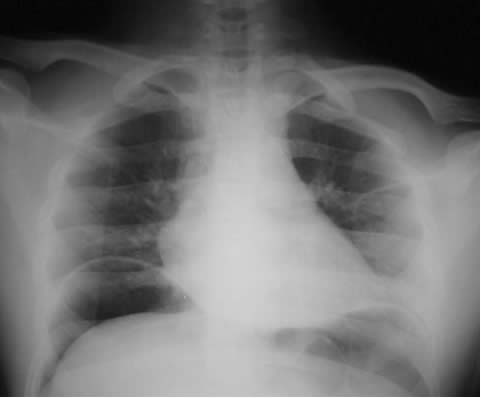 Figure 1
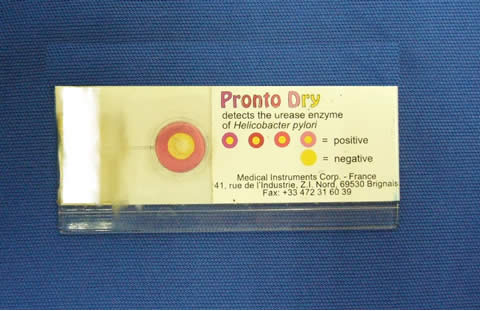 Figure 2
ANSWER:
- The erect chest radiograph of the patient shows “free air under diaphragm”. ( Figure 3)
 Figure 3
- Perforated gut. With the history of long-term NSAIDs usage, the most likely diagnosis is perforated peptic ulcer. In a local published studies, the most common site of gastrointestinal perforation was at the stomach (45.7%), followed by duodenum (18.5%), oesophagus (9.9%), small intestine (9.9%), and large intestine (16.0%).1 Free air in the peritoneum cavity also occurs in the following condition (not for this patient):
- Penetrating abdominal injury
- Recent abdominal laparotomy/laparoscopy
- After peritoneal dialysis
- Ruptured pneumatosis intestinal cysts
- Diagram 2 shows the positive result of a Pronto Dry test. Pronto Dry test is one of the rapid urease tests for detecting Helicobacter pylori. Positive test is indicated by the change of colour of the reagent ring from yellow to red. There are overwhelming evidences to confirm that Helicobacter pylori infection plays a significant role in the development of chronic active gastritis, peptic ulcer, MALT lymphoma and gastric adenocarcinoma.2 Patients presenting with recurrent dyspepsia and those with confirmed peptic ulcers must be screened for Helicobacter pylori, so that eradication therapy can be instituted once infection is confirmed. The Pronto Dry test has sensitivity similar to the older CLO test.3 The other advantage is the results of Pronto Dry test can be obtained more rapidly and it is cheaper.3,4 Furthermore, the Pronto Dry test can be stored at room temperature without special storage requirement, hence it is feasible and convenient for many primary care doctors who performed upper GIT endoscopy.
Reference
- Murty OP, Lye YF, Tan LS, Nurull Eddayu H, Nurul Azwa MI. Fatal gastrointestinal perforations in sudden death cases in last 10 years at UMMC Malaysia. Internet Journal of Medical Update. 2007;2(1) [Full text]
- Blaser MJ. Ecology of Helicobacter pylori in the human stomach.J Clin Invest. 1997;100(4):759-62 [PubMed] [Full text]
- Said RM, Cheah PL, Chin SC, Goh KL. Evaluation of a new biopsy urease test:Pronto Dry, for the diagnosis of Helicobacter pylori infection. Eur J Gastroenterol Hepatol 2004; 16(2):195-199. [PubMed] [Full text]
- Perna F, Ricci C, Gatta L, et al. Diagnostic accuracy of a new rapid urease test (Pronto Dry), before and after treatment of Helicobacter pylori infection. Minerva Gastroenterol Dietol. 2005;51(3):247-54 [PubMed]