

Welcome to the
Malaysian Family Physician, a peer-reviewed open-access journal of family practice
and primary care research.
EMB COMMENTARY

WHITE COAT EFFECT AND WHITE COAT HYPERTENSION: ONE AND THE SAME?
AS Ramli MBBS (Newcastle-upon-Tyne), DFFP (UK), DRCOG (UK), MRCGP (UK)
Senior Lecturer & Family Medicine Specialist, Faculty of Medicine, Universiti Teknologi MARA (UiTM), Shah Alam, Selangor, Malaysia
N Halmey MBBS (Newcastle-upon-Tyne), MRCP (UK)
Consultant Cardiologist, Gleneagles Intan Medical Centre, Kuala Lumpur, Malaysia
CL Teng, MMed (Fam Med), FRACGP, FAMM
Professor, Department of Family Medicine, International Medical University, Seremban, Negeri Sembilan, Malaysia
Address for correspondence: Dr Anis Safura Ramli, Senior Lecturer & Family Medicine Specialist, Primary Care Medicine Discipline Coordinator, Faculty of Medicine, Universiti Teknologi MARA, 40450 Shah Alam, Selangor, Malaysia. Email: rossanis_yuzadi@yahoo.co.uk
Conflict of interest: None
Abstract
White coat hypertension (WCHT) and white coat effect (WCE) are often thought to be of the same entity. They are in fact different conditions which carry distinctive definitions and prognostic significance. WCHT is diagnosed when office blood pressure (OBP) is ≥140/90 mmHg on at least 3 occasions, while the average daytime or 24-hour blood pressure is <135/85 mmHg. It is common with 15% prevalence in the general population and may account for over 30% of individuals in whom hypertension is diagnosed. Although individuals with WCHT were reported to have a better cardiovascular (CV) prognosis when compared to those with sustained hypertension and masked hypertension; they were also shown to have a greater prevalence of target organ damage (TOD) and metabolic abnormalities than that of normotensive subjects. In contrast, WCE is defined as the transient elevation of OBP induced by the alerting response to a doctor or a nurse. WCE can occur in both normotensive and hypertensive persons; and is not substantially influenced by reassurance and familiarisation. There is conflicting evidence with regards to prognostic significance of WCE, where most data indicated that it does not predict future TOD, CV morbidity or mortality; with some studies showed otherwise. This case scenario aims to solve the diagnostic perplexity with regards to WCHT and WCE, followed by an evidence-based commentary of how to best manage such conditions.
Ramli AS, Halmey N, Teng CL. White coat effect and white coat hypertension: one and the same? Malaysian Family Physician. 2008;3(3):xx-xx
CASE SCENARIO
A 60-year-old woman attended for regular follow-up at a primary care clinic. She had been diagnosed with hypertension for 10 years and currently took atenolol 50 mg daily. She was otherwise well apart from some domestic stress. Her physical findings were normal. Her blood pressure (BP) measured in the clinic (using a mercury sphygmomanometer, Accoson) on this visit was 166/98 mmHg and 144/104 mmHg (measured by two different people). She expressed surprised, saying that her home BP was better than this. She took her medication diligently and was not keen to have it changed.
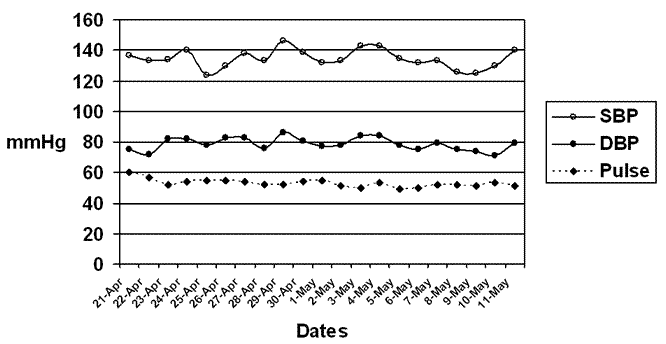
During second clinic visits, her BP readings was 196/110 mmHg. She brought along her home BP readings (see Figure 1 below), recorded using a newly bought digital BP set (Omron HE-705-C12). During her third clinic visit, her blood pressure readings measured in the clinic were 180/100 mmHg (using mercury BP set) and 186/96 mmHg (using her own digital BP set).
Some of her investigation results are shown below:
Urinalysis: urine protein negative, urine microalbumin negative
Chest X Ray: Cardiomegaly (CTR 14/21 cm)
ECG: left ventricular hypertrophy (LVH) by voltage criteria
Fasting glucose: 6.4 mmol/L
Renal profile: normal
Fasting lipid: TC 5.1, LDL-C 3.0, TG 2.1, HDL-C 1.19, risk 4.3
Echocardiogram: Ejection fraction (EF) 61%, mildly dilated left atrium (LA), other chambers normal size. Left ventricular (LV) function normal. No left ventricular hypertrophy (LVH). No evidence of diastolic dysfunction.
Questions
- White-coat hypertension and white coat effect - are the two conditions of the same entity?
- Which diagnostic category would this lady fall into- white-coat hypertension or hypertension with white-coat effect?
- How should we manage this lady?
COMMENTARY
White coat hypertension (WCHT) and the white coat effect (WCE) are frequently and erroneously referred to as the same entity.1 It must be stressed that WCHT and WCE are different conditions which carry distinctive definitions and prognostic significance. The more descriptive term ‘isolated office hypertension’ (IOH) has been suggested as a preferable alternative to WCHT, in order to minimise confusion with WCE.2
White coat hypertension (WCHT)
WCHT or IOH is diagnosed when office blood pressure (OBP) is ≥140/90 mmHg on at least 3 occasions, while the average daytime or 24-hour blood pressure is <135/85 mmHg.2 Self measurement of blood pressure (SMBP) has been proposed as a useful alternative to the ambulatory blood pressure monitoring (ABPM) to measure the average daytime BP.2
The prevalence of WCHT in the general population is approximately 15% and it may account for over 30% of individuals in whom hypertension is diagnosed.3 Most studies reported that individuals with WCHT have a better cardiovascular (CV) prognosis when compared to those with sustained hypertension and masked hypertension; but a worse prognosis than normotensives.4-6 Individuals with WCHT have also been shown to have a greater prevalence of target organ damage (TOD) and metabolic abnormalities than that of normotensive subjects.4
Antihypertensive drug treatment should be instituted in patients with WCHT when there is evidence of TOD or a high CV risk (≥20% over 10 years).1,2 Therefore, identification of WCHT should be followed by a search for metabolic risk factors and organ damage. Lifestyle intervention, a close follow-up and regular assessment of risk factors are recommended for individuals with uncomplicated WCHT not requiring pharmacological treatment.1,2
White coat effect (WCE)
WCE is defined as the transient OBP elevation induced by the alerting response to a doctor or a nurse.1,2 It usually averages about 20/10 mmHg with the maximal rise taking place 1-4 minutes after the doctor’s/nurse’s arrival, but can persist for up to 10-15 minutes.1 WCE can occur in both normotensive and hypertensive persons; and is not substantially influenced by reassurance and familiarisation with the technique or the circumstances of the BP measurement.1
A study has shown that ambulatory WCE was greater in women than in men, in treated than in untreated patients; and increased with higher body mass index (BMI) and with advancing age.7 In terms of prognostic significance, most data seem to indicate that the WCE does not predict future target organ damage,8,9 or CV morbidity or mortality,10 but at least two studies showed otherwise.11,12
Which diagnostic category would this lady fall into?
A person with a high OBP and a large WCE may also show elevated average daytime or 24-hour blood pressure, and thus have hypertension with WCE. Conversely, a person with a sustained OBP elevation (≥140/90 mmHg) and a small WCE may show a normal average daytime or 24-hour ambulatory blood pressure (<135/85 mmHg), and thus have WCHT. Although WCHT is a consequence of WCE, there is no automatic association between the two.
In this particular case, it is obvious that this lady has a large WCE when her BP is measured in the clinic. Her BP should be measured again at the end of the clinic visit to find out whether or not her WCE is sustained. Her SMBP has an average of 140/80mmHg (as shown in Figure 1) while she diligently takes her atenolol. It is most likely that this lady has hypertension with a large WCE, but ideally, she needs to be referred for an ABPM to reconfirm her SMBP readings to ascertain whether her hypertension is truly controlled.
How should we manage this lady?
Management of this lady should take into consideration her global cardiometabolic risk and the presence of TOD. Her blood investigations demonstrated elevated fasting glucose and triglycerides levels. According to the NCEP ATP III13 (Figure 2), this lady fulfills three of the five components required to be diagnosed as having metabolic syndrome. Although her ECG indicated left ventricular hypertrophy (LVH) by voltage criteria, her echocardiogram confirmed that there is no presence of LVH and her LV function is normal.
Figure 2. Metabolic Syndrome components by NCEP ATP III13 and IDF definition14| MetS Components | Waist Circumference(WC) |
Triglycerides | HDL-C | Fasting Glucose | Blood Pressure(BP) |
|---|---|---|---|---|---|
Diagnosis by NCEP ATP III: |
*Men≥90 cm |
≥1.7 mmol/L |
Men <1.03 mmol/L |
≥6.1 mmol/L |
≥130 or ≥85 mmHg |
Diagnosis by IDF Definition: WC + 2 components |
WC is a mandatory criteria |
≥1.7 mmol/L |
Men <1.03 mmol/L |
≥5.6 mmol/L |
≥130 or ≥85 mmHg |
*The NCEP criteria has been modified for Asians by changing the WC to the Asian standard15
**The WC for IDF definition is based on South Asians (Chinese, Malay, Asian-Indian) population14
When compared with other antihypertensive agents, beta-blockers have been shown to be associated with 16% increase in the risk of stroke16 and an excess cardiovascular event risk of 18% in older patients (≥60years)17. It has also been shown to increase the incidence of new-onset diabetes compared to other drugs, especially in those with high metabolic risk.18 They are the least effective agents in terms of LVH regression19,20 and also reduce central aortic pressure less effectively than newer antihypertensive agents21. Beta-blockers are no longer recommended for first line monotherapy in newly-diagnosed uncomplicated hypertension without compelling indication for any specific drug.16,22 However, it should be emphasised that beta-blockers should be prescribed when compelling indications such as heart failure and ischaemic heart disease coexist.
In view of this compelling evidence, there is a good case to convince this lady that her blood pressure should indeed be treated more effectively, preferably by changing her beta-blocker to another agent. The renin-angiotensin system inhibitors would be the preferred agents in the treatment of hypertensives with both metabolic syndrome and LVH.
The key to the management of this lady is to regard her as a partner in managing her condition by educating her regarding the metabolic risk and sharing with her in simple terms, why such treatment is recommended. Lifestyle interventions such as dietary modification, regular exercise and salt reduction should continue to be strongly emphasised in all patients.
REFERENCES
- Celis H, Fagard RH. White-coat hypertension: a clinical review. Eur J Intern Med. 2004;15(6):348-57 [PubMed]
- European Society of Hypertension and European Society of Cardiology Task Force. 2007 Guidelines for the management of arterial hypertension. J Hypertens. 2007;25(9):1105-87 [PubMed] [Full text]
- Hansen TW, Jeppesen J, Rasmussen S, et al. Ambulatory blood pressure monitoring and risk of cardiovascular disease: a population based study. Am J Hypertens. 2006;19(3):243-50 [PubMed]
- Mancia G, Facchetti R, Bombelli M, et al. Long-term risk of mortality associated with selective and combined elevation in office, home, and ambulatory blood pressure. Hypertension. 2006;47(5):846-53 [PubMed] [Full text]
- Ohkubo T, Kikuya M, Metoki H, et al. Prognosis of masked hypertension and white-coat hypertension detected by 24-h ambulatory blood pressure monitoring. J Am Coll Cardiol. 2005;46(3):508-15 [PubMed] [Full text]
- Verdecchia P, Reboldi GP, Angeli F, et al. Short- and long-term incidence of stroke in white-coat hypertension. Hypertension. 2005;45(2):203-8 [PubMed] [Full text]
- Den Hon E, Celis H, Vandenhoven G, et al. For the THOP investigators. Determinants of white-coat syndrome assessed by ambulatory blood pressure or self-measured home blood pressure. Blood Press Monit. 2003;8(1):37-40 [PubMed]
- Parati G, Mancia G. White-coat effect: semantics, assessment and pathophysiological implications. J Hypertens. 2003;21(3):481-6 [PubMed]
- Lantelme P, Milon H, Vernet M, et al. Difference between office and ambulatory blood pressure or real white-coat effect: does it matter in terms of prognosis? J Hypertens. 2000;18(4):383-9 [PubMed]
- Verdecchia P, Schillaci G, Borgioni C, et al. Prognostic significance of the white-coat effect. Hypertension. 1997;29(6):1218-24 [PubMed] [Full text]
- Munakata M, Saito Y, Nunokawa T, et al. Clinical significance of blood pressure response triggered by a doctor’s visit in patients with essential hypertension. Hypertens Res. 2002;25(3):343-9 [PubMed] [Full text]
- Mule G, Nardi E, Cottone S, et al. Relationship between ambulatory white-coat effect and left ventricular mass in arterial hypertension. Am J Hypertens. 2003;16(6):498-501 [PubMed]
- Executive Summary of the Third Report of the National Cholesterol Education Program (NCEP) Expert Panel on Detection, Evaluation, and Treatment of High Blood Cholesterol in Adults (Adults Treatment Panel III). JAMA. 2001; 285(19):2486-97 [PubMed] [Full text]
- The IDF Consensus Worldwide Definition of the Metabolic Syndrome. http://www.idf.org/webdata/docs/IDF_Metasyndrome_definition.pdf.
- Grundy SM, Cleeman JI, Daniels SR, et al. American Heart Association; National Heart, Lung, and Blood Institute. Diagnosis and management of the metabolic syndrome: an American Heart Association/National Heart, Lung, and Blood Institute Scientific Statement. Circulation. 2005;112:e285-e290 [Full text]
- Lindholm LH, Carlberg B, Samuelsson O. Should beta-blockers remain first choice in the treatment of primary hypertension? A meta-analysis. Lancet. 2005;366(9496):1545-53 [PubMed]
- Khan N, McAlister FA. Re-examining the efficacy of beta-blockers for the treatment of hypertension: a meta-analysis. CMAJ. 2006;174(12):1737-42 [PubMed] [Full text]
- Elliot WJ, Meyer PM. Incident diabetes in clinical trials of antihypertensive drugs: a network meta-analysis. Lancet. 2007;369(9557):201-7 [PubMed]
- Schmieder RE, Martus P, Klinbeil A. Reversal of left ventricular hypertrophy in essential hypertension. A meta-analysis of randomized double-blind studies. JAMA. 1996;275(19):1507-13 [PubMed]
- Dahlof B, Devereux RB, Kjeldsen SE, et al. Cardiovascular morbidity and mortality in the Losartan Intervention for Endpoint reduction in hypertension study (LIFE): a randomized trial against atenolol. Lancet. 2002;359(9311):995-1003 [PubMed]
- Williams B, Lacy PS, Thom SM, et al. Differential impact of blood pressure-lowering drugs on central aortic pressure and clinical outcomes: principal results of the Conduit Artery Function evaluation (CAFÉ) study. Circulation. 2006; 113(9):1213-25 [PubMed] [Full text]
- Malaysian Hypertension Guideline Working Group. Clinical Practice Guidelines on Management of Hypertension. 3rd edition. 2008. MOH/P/PAK/156.08 (GU). [Full text]