

Welcome to the
Malaysian Family Physician, a peer-reviewed open-access journal of family practice
and primary care research.
TEST YOUR KNOWLEDGE

AN ELDERLY WOMAN WITH UNRESOLVED ‘STYE’ OVER HER RIGHT LOWER EYE LID
Y Azhany1, D Nani2
1Department of Ophthalmology, Universiti Sains Malaysia, Kubang Kerian, Kelantan (Azhany Yaakub)
2Department of Family Medicine, Universiti Sains Malaysia, Kubang Kerian, Kelantan (Nani Draman)
Address for correspondence: Dr Azhany Yaakub, Department of Ophthalmology, School of Medical Sciences, Health Campus, Universiti Sains Malaysia, Kubang Kerian, Kelantan, Malaysia. Tel: 609-767 6352 / 6362, Fax: 609-765 3370, Email: azhany@kb.usm.my
Azhany Y, Nani D. An elderly woman with unresolved ‘stye’ over her right lower eye lid. Malaysian Family Physician. 2010;5(3):155-156A 62-year-old Malay woman presented to the primary care clinic with a complaint of right lower eye lid swelling for four months. The lesion was painless and slowly enlarging in size. There was no eye discharge or visual disturbance. She was treated by several general practitioners as stye and chalazion but there was no improvement. Other than hypertension, there was no other medical illness of note.
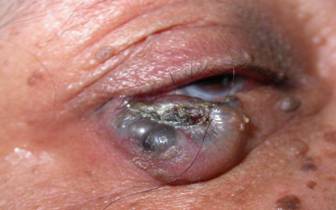
Examination revealed a swelling at the lower eye lid extending to the lid margin and lateral canthus. The lesion, measuring about 2x2 cm, has a rolled edge, with an eroded area and blackish (necrotic) area. The surrounding skin is in normal appearance with no sign of inflammation (Figure 1).
QUESTION:
- What is the most likely diagnosis?
- What is the differential diagnosis?
- What further investigations should be done?
- What are the treatment options?
ANSWER:
- The most likely diagnosis is basal cell carcinoma (BCC), nodular subtype with ulceration. Nodular subtype is the most common presentation of BCC. This clinical diagnosis is based on the fact that the swelling was slowly progressive without symptoms of inflammation and unresponsive to treatment, the features of swelling also suggestive of BCC.
- The differential diagnosis is squamous cell carcinoma.
- Further investigations done were CT scan of orbit, head and neck region, and biopsy of the skin lesion.
- Head and neck region is the most common part of the body presented with BCC. Periorbital area especially the eyelids need special attention because of its function as the eye protector from the dryness and trauma. Defect of the eyelids might cause exposure keratopathy and keratitis which potentially lead to blindness.
The treatment of BCC over the eyelid depends on few factors:
- Size - small (less than one-third of the eyelid) or large.
- Location - medial canthus region might involve the lacrimal duct system, lateral canthus might involved the lacrimal gland.
- Spread - local extension or lymph nodes extension.
- Options of treatment for localized non-metastased BCC include radiotherapy and surgery. However, radiotherapy is indicated only for small tumour less than one-third involvement of eyelid or about 3 cm or less. In this patient, surgical treatment is the best option. Surgical treatment has three aims: complete tumour removal, preserve functionality and good aesthetic outcome. This patient underwent surgical reconstructive eyelid surgery (combination of Mustarde cheek rotation flap, buccal mucosa and ear cartilage grafts).
ACKNOWLEDGEMENT
We wish to thank Associate Professor Dr Liza Sharmini Ahmad Tajuddin, the main surgeon managing this patient.
REFERENCES
- Allali J, D’Hermies F, Renard G. Basal cell carcinomas of the eyelids. Ophthalmologica. 2005;219(2):57-71. [PubMed]
- Sassoon EM, Codner MA. Eyelid reconstruction. Operative Techniques in Plastic and Reconstructive Surgery. 1999;6(4):250-64.
- Collin JRO. A manual of systematic eyelid surgery. 2nd ed. London: Churchill Livingstone; 1989. p. 89-91.
- Yap FB. Clinical characteristics of basal cell carcinoma in a tertiary hospital in Sarawak, Malaysia. Int J Dermatol. 2010;49(2):176-9. [PubMed]
- Scrivener Y, Grosshans E, Cribier B. Variations of basal cell carcinomas according to gender, age, location and histopathological subtype. Br J Dermatol. 2002:147(1):41-7. [PubMed]