

RESEARCH NOTES
WHAT STUDY DESIGN SHOULD I CHOOSE?
OBSERVATIONAL STUDY
At times, well conducted qualitative study may provide sufficient data for you to act on. More often, the findings of the qualitative study provide the fodder for a formal questionnaire survey (see next Research Notes). Let's say your qualitative study found that the reasons why your patient did not turn up for the appointment were: forgot appointment date, no transport, admission to hospital and wrong appointment date. In addition, a few patients who had defaulted in the past were also having microvascular complications and had recent admissions to hospital.
To find out how common default really is, you will need to conduct a questionnaire survey among all your diabetic patients. Questionnaire survey (and all study designs described later) collected discreet data that can be analysed further using statistical methods – they are thus called quantitative research methods.6 In questionnaire survey, depending on the nature of research question and its complexity, data can be obtained in few ways: self-completion questionnaire, face-to-face interviews, telephone interviews and postal questionnaire.
The questionnaire survey (also known as cross-sectional study) allows you to determine the characteristics of the defaulters more accurately. You can also determine their reasons for not turning up and whether they had any complications or hospitalisations. Thus, cross-sectional study may show an association between default and hospitalisations. Sometimes it is difficult to decide the direction of this relationship (Is default the cause or the effect of hospitalisation?), this is because the data on default and hospitalisation were collected at the same time.Box 2. Observational study (see Figure 1)
In case-control study, two groups of research subjects are chosen first: cases (e.g. diabetic patients with hospitalisation) and controls (e.g. diabetic patients without hospitalisation). The researcher goes through the past records of these subjects (both cases and controls) to find out whether they were frequent defaulters or not. Thus, in a typical case-control study, the data collection is mainly retrospective (backward in time). The selection of cases and controls is an important issue in this study design.
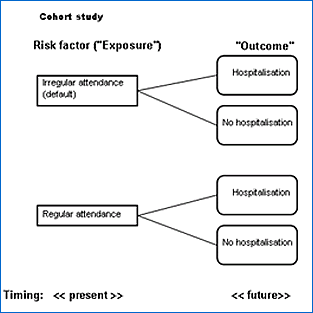
Cohort study begins with a group of subjects (some may be frequent defaulters, others regular attenders) but free of the condition of interest (e.g. no hospitalisation). All the subjects are followed up and observed for the occurrence of hospitalisations. In contrast to the case-control study, cohort study is usually prospective (forward in time). It provides the best information about the cause of disease plus the most direct measurement of the risk of developing that particular outcome. The difficulties of conducting a cohort study are: large number of subjects, long period of follow-up for the event of interest to develop, high cost and lost to follow up.Figure 1. Observation studies


Let's say we postulate that diabetic patients who frequently default their follow-up would be hospitalised later due to diabetic complications. To prove (or disprove) this hypothesis, we can use either case control study or cohort study; these two study designs, together with cross-sectional study, are known
<< Page 1 | 2 | 3 >>