


REVIEW ARTICLES

SUMMARIZING RESEARCH FINDINGS: SYSTEMATIC REVIEW AND META-ANALYSIS
LP Wong, MSc, PhD
Lecturer, Health Research Development Unit (HeRDU), Faculty of Medicine, University
of Malaya
Address for correspondence: Dr Wong Li Ping, Lecturer, Health Research Development Unit (HeRDU), Faculty of Medicine, University of Malaya, 50603 Kuala Lumpur, Malaysia. Tel: 603-79675738, Fax: 603-79675769, Email: wonglp@ummc.edu.my
ABSTRACT
The explosion of biomedical publishing makes keeping up with the primary studies
an impossible task. The often disparate, confusing and contradicting findings
of individual studies makes healthcare professionals turn to review articles
where knowledge has been collated and published in summaries. Narrative reviews
are known as the lack of rigorous, systematic and reproducible synthesis. In
contrast, systematic reviews are conducted using systematic and explicit methods
to identify, select and critically appraise relevant research, and to collect
and analyse data from the studies that are included in the review. The final
pathway for systematic review is a statistical summary of the results of primary
studies, or meta-analysis. This article provides some guidelines to health
care providers in understanding the key aspects of systematic review and meta-analysis.
Steps involved in systematic review are discussed. The potential pitfall of
meta-analysis was also explored.
Wong LP. Summarizing research findings: systematic review and meta-analysis.
Malaysian Family Physician. 2007;2(1):8-1
THE NEED FOR REVIEWS
The huge amount of medical information available and its exponential growth have
become common problem in the literature of biomedical information. Health care
practitioners face the explosion in biomedical knowledge which makes keeping
up with the primary research an impossible feat. There are approximately 17,000
new biomedical books published every year along with 30,000 biomedical journals,
with an annual increase of 7%. For instance, MEDLINE alone contains more than
eleven million citations, and more than 400,000 articles are added to the file
each year.1 Majority health care providers noted that the current volume of
scientific literature is unmanageable2 and often do not have sufficient time
for reading medical journals as the information explosion continues.3 Further,
some of these studies could be unclear, confusing or may also have contradicting
results.
THE NARRATIVE REVIEWS
To make this task easier and manageable for health care providers as well as decision makers, often reviews are among their information resources. Reviews have always been a part of the medical literature. Traditionally, the medical research has been integrated in the narrative or nonsystematic form. An expert in a particular field will review studies, decided on the relevance, and highlight the findings, both in terms of results and, to a lesser degree the methodology.4 Such narrative reviews tend to be unsystematic and susceptible to many biases. Firstly, no systematic approach is prescribed to obtain the primary data and to integrate the data. Often, subjective judgment of the reviewer was used. There were often no explicit standards exist to assess the quality of review. Moreover, narrative reviewer also does not synthesize data quantitatively.
A CALL FOR SYSTEMATIC REVIEWS
A systematic review is defined by the Cochrane Handbook as ‘A review
of a clearly formulated question that uses systematic and explicit methods
to identify, select and critically appraise relevant research, and to collect
and analyse data from the studies that are included in the review’.
In contrast to narrative review, systematic review allows readers to appraise
how the review was conducted and synthesized. It is of particular value
in bringing together a number of separately conducted studies, sometimes
with conflicting findings, and synthesizing their results. Systematic reviews
have been proven to be able to yield valid, precise, and widely applicable
answers to clinical questions.5, In short, systematic reviews summarise large
amounts of information and are more likely than individual trials to describe
the true clinical effect of an intervention. Thus, systematic reviews have
come to play a central role in informing clinical decisions and guidelines.
A systematic review is also often called an ‘overview’.
A meta-analysis takes a systematic review one step further by statistically pooling the results of combinable studies. Since its introduction, meta-analysis has established itself as an influential branch of clinical epidemiology and health services research, with hundreds of meta-analyses published in the medical literature each year.6
THE PROCESS OF SYSTEMATIC REVIEW
Systematic review should be carefully planned with a detailed written protocol
prepared in advance as any other search project. Systematic review involves
several discrete steps and the steps are summarised below.
Step 1: Formulate review question. This requires the formulation of a clear statement of relevant patient groups, intervention of interest, as well as outcomes. The details are used to select studies for inclusion in the review.
Step 2: Locate studies. Systematic review must be undertaken in accordance with a predefined search strategy that would allow the completeness of the search to be assessed. Search strategies should consider the following sources: The Cochrane Controlled Trials Register (CCTR), other electronic databases and trials registered not covered by CCTR, checking reference lists, hand searching of key journals and personal communication with experts in the fields. The selection of primary studies is governed by inclusion and exclusion criteria that are initially specified when the protocol is defined.
Step 3: Appraising the quality of studies. After an exhaustive search, all possible primary studies that have been identified need to be assessed for eligibility for inclusion. Application of stringent inclusion/exclusion criteria should be addressed for example types of participants, interventions, outcomes, study designs and methodological quality. Independent assessment by more than one observer is desirable.
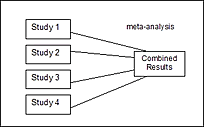
Step 4: Combining the results. The findings from combinable individual primary studies are then pooled to produce an ‘overall estimate’ on the clinical effectiveness of the intervention. The aggregation can be qualitative, or more appropriate, by statistically combining the data produced by individual studies into a single summary estimate. The statistical pooling of data is termed meta-analysis (Figure 1). In meta-analysis, results from studies are combined using ‘inverse variance method’, whereby larger studies and studies with less random variation are given greater weight than smaller studies.Figure 1. Meta-analysis: Data from several different studies are combined and produce a single estimate
 Meta-analysis
can only be undertaken when studies address the same question, administer
the intervention in a similar manner or measure the same outcomes. When
studies differ in one or more of these components, meta-analysis is not
appropriate. Therefore, systematic review may or may not include meta-analysis.
Meta-analysis
can only be undertaken when studies address the same question, administer
the intervention in a similar manner or measure the same outcomes. When
studies differ in one or more of these components, meta-analysis is not
appropriate. Therefore, systematic review may or may not include meta-analysis.
