


REVIEW ARTICLES

SUMMARIZING RESEARCH FINDINGS: SYSTEMATIC REVIEW AND META-ANALYSIS
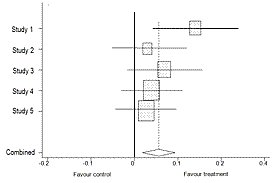
In meta-analysis, for outcomes measured on a continuous scale, the weighted mean difference is commonly used. For outcomes measured on a dichotomous scale, common approaches include the use of odds ratio or relative risk. There are two approaches for combining the data: fixed-effects model assume that an intervention has a single true effect whereas random-effects models assume that an effect may very across studies.7 The results of meta-analysis can be displayed graphically (Forest plot) to allow a visual comparison of findings of individual studies (Figure 2).
Figure 2. Forest plot of meta-analysis
 Systematic
review should continue with an investigation of the reasons for heterogeneity.
Subgroup analysis, sensitivity analysis and meta-regression are frequently
used to investigate heterogeneity of individual studies in meta-analysis.
One of the major drawbacks to using meta-analysis is the possibility
of publication bias. One way to investigate whether a review is subject
to publication bias is to prepare a ‘funnel plot’ (Figure
3) and examine this for signs of asymmetry.8
Systematic
review should continue with an investigation of the reasons for heterogeneity.
Subgroup analysis, sensitivity analysis and meta-regression are frequently
used to investigate heterogeneity of individual studies in meta-analysis.
One of the major drawbacks to using meta-analysis is the possibility
of publication bias. One way to investigate whether a review is subject
to publication bias is to prepare a ‘funnel plot’ (Figure
3) and examine this for signs of asymmetry.8
Step 5: Interpret results. The findings from systematic review and statistical pooling of the studies then need to be interpreted, discussed and set out the implications for practice or further research. Issues such as the quality and heterogeneity of the included studies, the possible impact of bias need to be discussed.

PITFALLS AND PROBLEMS
Meta-analyses have received mixed receptions. Some see that meta-analysis as
an exercise of ‘mega-siliness’,9 ‘a tool has become a weapon’10
and a number of statisticians think that meta-analysis represents the unacceptable
face of statisticism.11 There are also those that still prefer the conventional
narrative review article.12 The mixed receptions were due to opposite conclusions
observed in some systematic reviews that addressing the same issue.13,14 Also,
meta-analyses of small trials were discovered to contradict by a single large
randomized trial.15
Publication bias could be a serious problem for meta-analyses, secondly, studies may be of varying quality. Clearly the quality of trials included in a systematic review and meta-analysis is of crucial importance and should be of high methodological quality as well as free from biases. Meta-analysis should therefore be considered only within the framework of systematic review that has been prepared using a systematic approach to mitigate all kinds of biases and explicitly address the issue of the completeness of the evidence identified, the quality of component studies and the combinability of studies.15 The Cochrane Collaboration has been established to overcome this problem by providing high quality and authoritative systematic reviews and meta-analyses.16,17 The collaboration not only ensures that high-quality reviews are conducted but also update reviews when new evidence becomes available.
CONCLUSION
Systematic review is an invaluable resource for both clinicians and researchers. However, not all reviews are systematic and even those are described as systematicmay be methodologically flawed. Nonetheless, a high quality systematic review provides the best available evidence.
The usefulness of a systematic review can further be enhanced by statistical summary of the results by meta-analytical technique. Pooling individual studies may reduce the risk of random error, increase statistical power and allowing for a more accurate estimate of effect size.
SOME TERMINOLOGIES
Bias (synonym: systematic error): the distortion of the outcome, as a result of a known or unknown variable other than intervention (i.e. the tendency to produce results that depart from the “true” result).
Cochrane Collaboration: The Cochrane Collaboration is an international organization that aims to help people make well-informed decisions about healthcare by preparing, maintaining & promoting the accessibility of systematic reviews of the effects of healthcare interventions.
Cochrane Controlled Trials Register (CCTR): CCTR is a database of references to controlled trials in health care.
Critical appraisal: systematically finding, appraising and interpreting evidence of effectiveness. It is aimed to examine research evidence to assess its validity, results and relevance before using it to inform a decision.
Cumulative meta-analysis: the repeated performance of meta-analysis whenever a new trial becomes available for inclusion. In cumulative meta-analysis studies are added one at a time in a specified order.
